Why Our Menu Fits on One Piece of Chalk
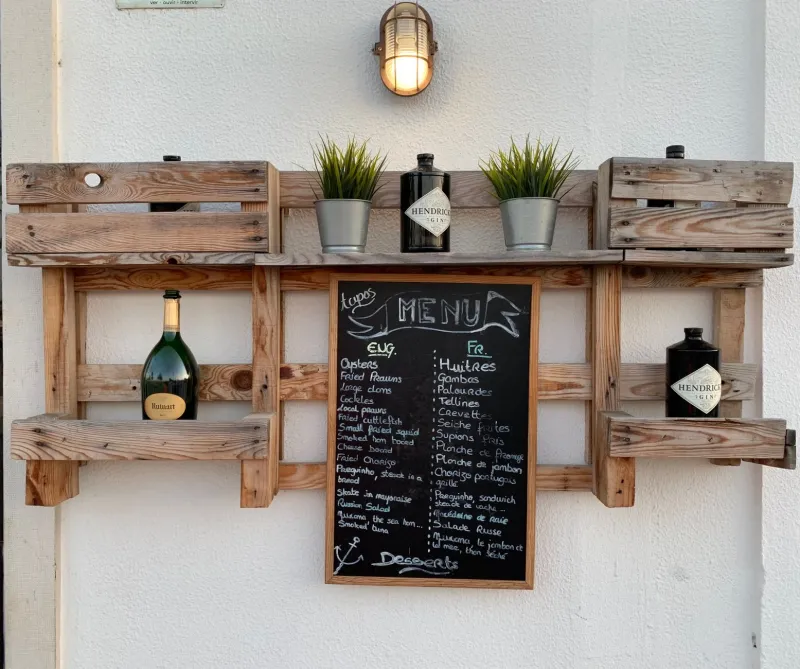
I have a theory, held for years and defended in several bars, that the length of a pub menu is inversely proportional to how much of it was made that morning. Nothing scientific about it. Just a lot of observation, and a lot of eating.
Ours fits on one piece of chalk. Six or seven things, maybe eight if the game is good and the veg patch has behaved. People sometimes say it apologetically on our behalf — 'is that all there is?' — and I understand why. We have spent thirty years being taught that more choice equals better value. But a short board is not a compromise. It is a promise, and it is one we would rather keep than break loudly across four laminated pages.
What a long menu is actually saying
Let me be fair. Some kitchens are built for length: big brigades, proper walk-ins, a supply chain that turns up twice a week with everything in a box. That is a legitimate way to run a restaurant, and when it is done well it is a joy.
A village pub kitchen is not that. Ours is small, warm, and staffed by people who also carry plates. If we offered forty dishes, something would have to give, and what gives is never the menu — it is the cooking. Long menus in small kitchens tend to mean freezers, bought-in components, and a lot of reheating dressed up as choice. Buying something in is not a crime; pretending you did not is the bit that sours.
The frost writes half the board
Here is the practical argument. Nobody in this kitchen decides in September what will be good in November. The weather decides, and we follow.
A hard frost does something remarkable to a parsnip — it converts the starch to sugar, and a root that was faintly soapy in October turns sweet and nutty by Bonfire Night. Sprouts want a cold snap before they stop being bitter. The first proper frost is the signal that the roots, the greens and the slow braises can take over the board. Until then, we are still cooking the tail end of the summer, and pretending otherwise would just mean buying in from somewhere warmer.
Game follows the same logic. Once the season is open and the shoots are shooting, pheasant and partridge arrive in far better condition than anything we could order in advance. When it is there, it goes on the board that week. When it is not, it does not.
Gluts, and the kindness of too much
Every gardener in Nassington knows the August problem: courgettes the size of your forearm, runner beans arriving faster than anyone can eat them, a plum tree that dumps a year's fruit in nine days.
A short menu lets us take a glut and put it front and centre for a week — a courgette and herb tart, a plum crumble, a chutney that quietly lives on the shelf for months. Then it comes off again. We can move at the speed of the garden.
A long menu cannot do that. A printed list of forty dishes has to pretend that everything is available always, which means most of it arrives in a van, from a wholesaler, at whatever quality the price allows. The glut goes in the bin while the kitchen serves imported beans in January.
Waste you can count
Fewer dishes means less prep, less stock sitting in the fridge, fewer half-used tubs going quiet at the back of the shelf. That matters for money, obviously, but it matters more for quality: the difference between a kitchen that is genuinely cooking and one that is merely assembling is usually visible in how much it throws away.
It also means we can buy better. Three kilos of pork from a farm we can name beats thirty kilos from a list, and the short board is what makes that affordable rather than indulgent.
The conversation is the point
This is the part people miss when they count the dishes. Ask the person behind the bar where the pork came from and they should be able to tell you — not from a folder, but because they know. Ask why the pie is off and the answer will be honest: we sold out, because we made twenty and twenty went.
That is a different kind of exchange to shrugging at a menu and hoping. When there are only six things, every one of them has a reason for being there, and the reason is usually a person within a few miles of this building.
What we are not saying
None of this is an argument against choice. We will always have a vegetarian dish that has had actual thought put into it rather than a stuffed pepper of last resort. We will always feed children properly and tell you the allergens straight rather than guessing. There will be a Sunday roast, and there will be something warming on a wet Tuesday in February.
What we will not do is pad the board so it looks more generous than the kitchen can honestly deliver.
A promise, written in chalk
We used to apologise for the size of the board. 'Sorry, that is all we have on.' We have stopped, because it was never a shortage — it was a decision, made every week, about what is best right now and what can wait until the frost comes.
So next time you count six dishes and wonder whether you are getting value, look at what is on the plate instead of what is missing from the list. Chalk wipes off. That is the whole point of it.